Preserve the original context.
The importer accepts three allowlisted Synthea patients from the SMART Health IT sandbox, verifies provenance and references, and preserves source Bundles and actual service dates.
From missing documentation to a reviewable appeal.
I built ClaimPath to make the next step in a claims investigation visible: identify the missing evidence, connect it to its source, prepare a draft, and keep a human responsible for approval.
Actual application: the overview brings evidence gaps and pending reviews into one queue. Click the image to enlarge.
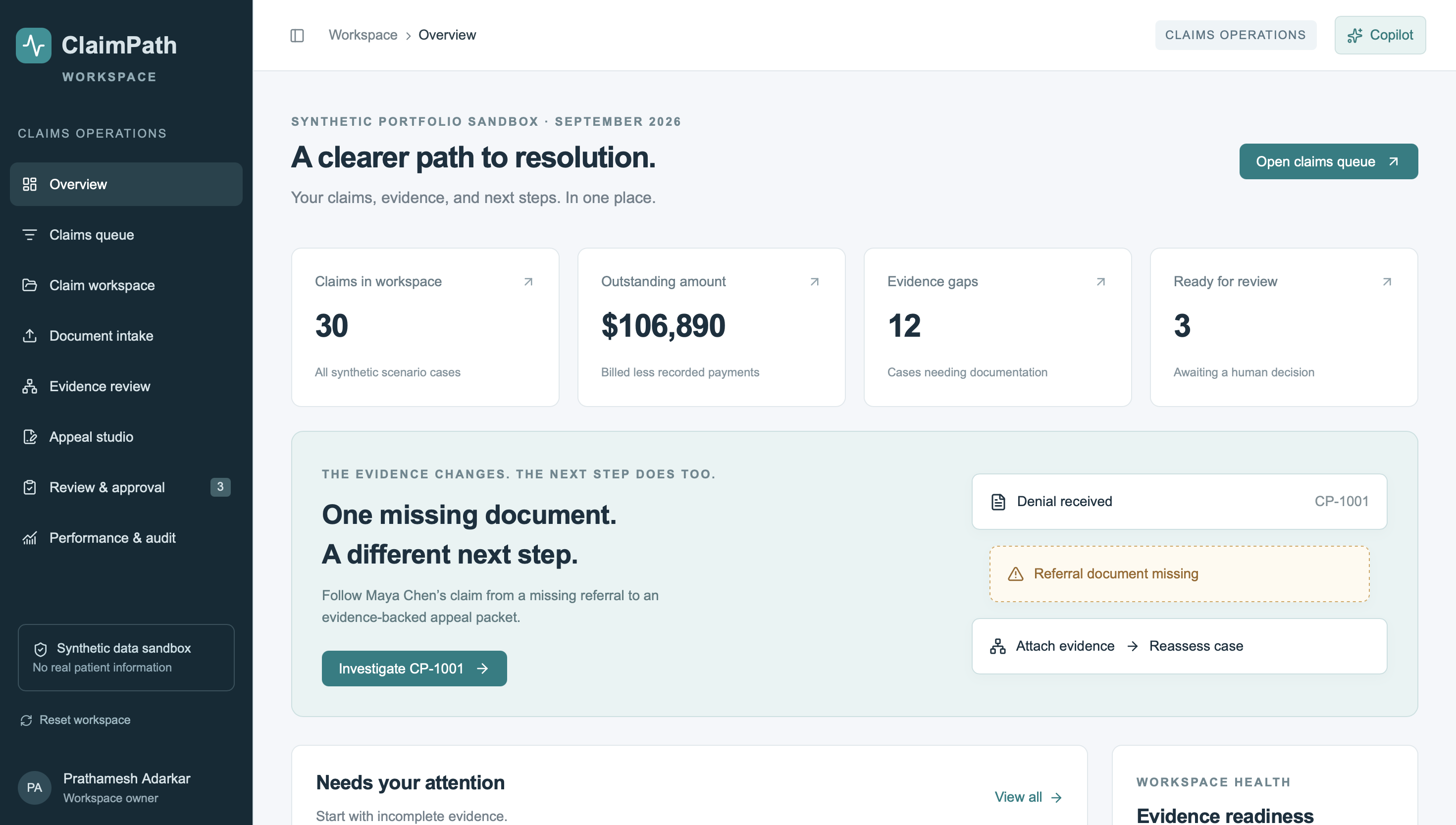
Screenshot not available yet.
Follow CP-1001, an authored case for Maya Chen. This interactive walkthrough explains the workflow; it does not modify the live application.
The case needs a referral document. A denial reason tells the reviewer where to investigate, but it does not establish that the required evidence is present.
Illustrative walkthrough of the implemented workflow. In the application, open CP-1001 and attach its sample referral to try it.
Claims investigation involves more than reading a status. A reviewer has to find the right document, check that it belongs to the case, understand what is still missing, and explain the request clearly enough for another person to review.
I designed ClaimPath around those handoffs. The queue leads into a claim workspace; documents feed evidence checks; the checks inform a draft; review decisions remain visible in the audit history.
Verified Synthea patients
Source references retained
Documents and identifiers
Explicit completeness checks
Editable draft
Supporting evidence nearby
Approve or request changes
Export and audit history
The importer accepts three allowlisted Synthea patients from the SMART Health IT sandbox, verifies provenance and references, and preserves source Bundles and actual service dates.
Next.js and TypeScript connect the eight screens. The Vercel edition uses PostgreSQL for session workspaces, documents, drafts, and audit events.
The evidence assistant provides rules-based answers. The code also supports server-side OpenAI explanations when an API key is configured. Approval stays with a person.
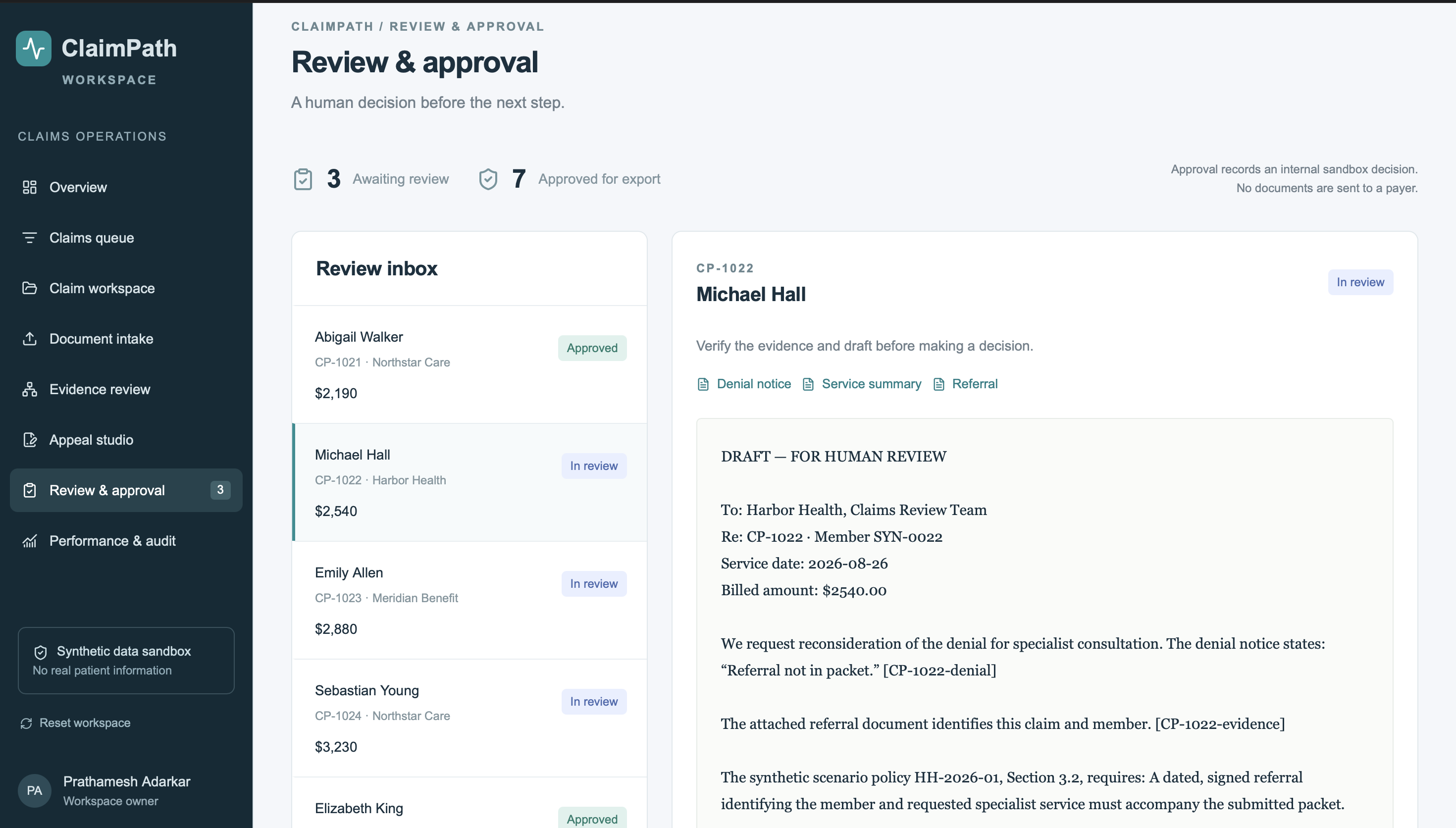
A document must match the claim and member identifiers, document type, and required marker. Attaching a file alone does not make a packet ready.
Editing or regenerating an approved draft invalidates approval. The updated request has to go through review again.
Imported clinical records retain their source. Payer names, financial amounts, denial reasons, and review targets are explicitly authored claim scenarios.
Open the claims queue, select CP-1001, and attach its sample referral under Document intake. Inspect the checks, generate a draft, and route it for review.
If the embedded view is unavailable or your browser restricts its session cookies, use the full application link.
Local integration checks covered incomplete-evidence blocking, document intake, draft-to-approval transitions, persistence, session separation, and invalidating approval after edits. Live FHIR checks covered all three patients, duplicate imports, mismatched references, and source provenance.
These checks establish application behavior. They do not establish clinical sufficiency, insurer acceptance, recovery rates, or time savings. Next I would test the workflow with claims reviewers and measure where they need to leave the workspace to complete a task.
All patient data is synthetic. Original claims are authored examples; imported clinical records are Synthea-generated data from the shared SMART Health IT FHIR R4 sandbox. Missing Coverage records do not imply lack of insurance. Evidence checks verify identifiers and markers, not medical necessity. Approval is internal; the application does not submit appeals to insurers.